October 20, 2026
H.C. Wainwright Initiates Equity Research Coverage of Hadron Energy Less Than Five Months After Nasdaq Listing
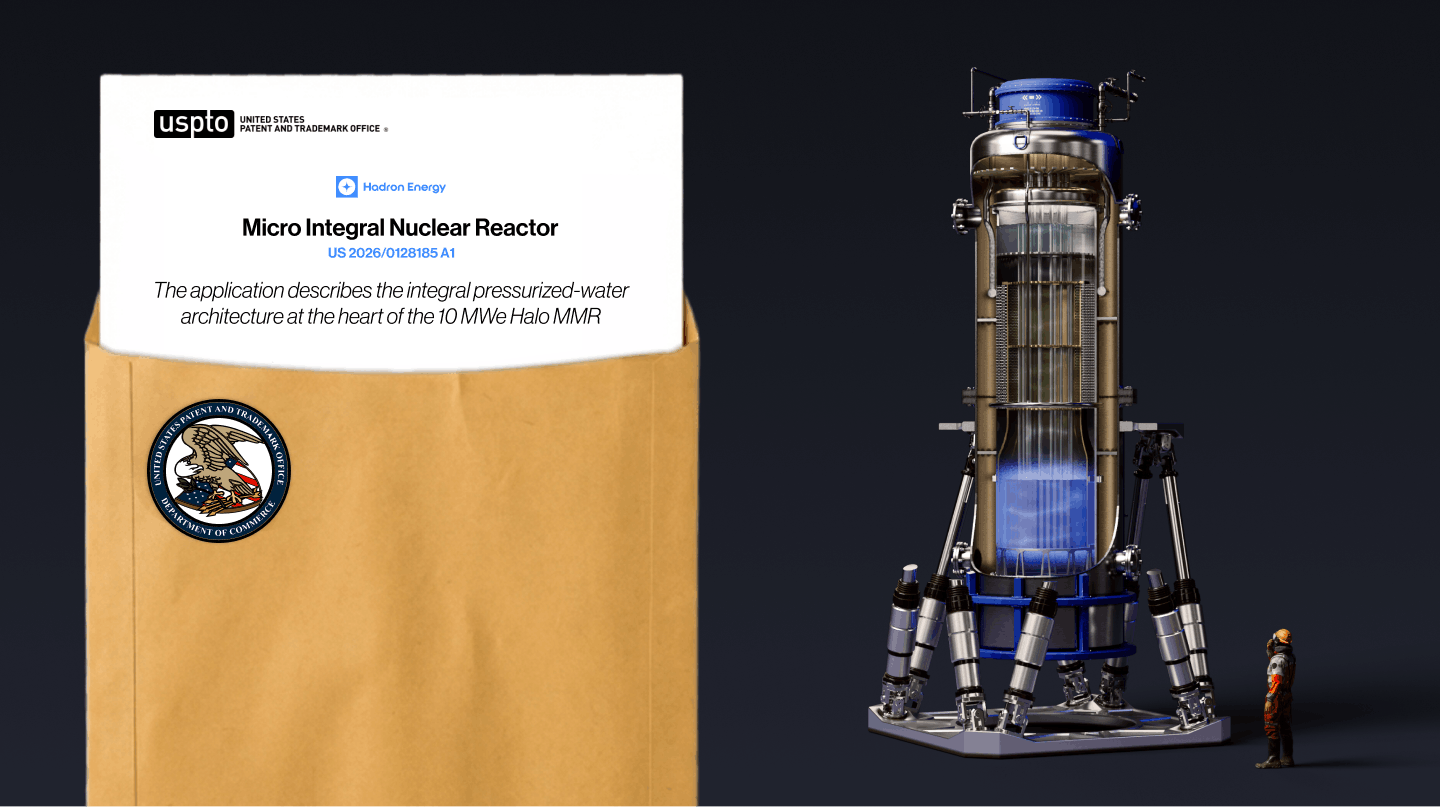
Hadron Energy's 10 MWe Halo MMR integrates the reactor core, steam generator, pressurizer, and primary coolant system in a single transportable pressure vessel, the architecture at the heart of the Company's first published U.S. patent application.
REDWOOD CITY, CA — June 16, 2026 — Hadron Energy, Inc. (Nasdaq: HDRN) (“Hadron” or the “Company”), an advanced nuclear technology company, today announced that the United States Patent and Trademark Office (USPTO) published the Company’s first patent application, “Micro Integral Nuclear Reactor” (Publication No. US 2026/0128185 A1), on May 7, 2026. The application is the foundational technical disclosure behind Hadron’s flagship Halo Micro-Modular Reactor (MMR) and the first entry in the Company’s growing intellectual property portfolio. Filed October 31, 2025 and claiming priority to a November 1, 2024 provisional application, it names Founder and Chief Executive Officer Samuel Gibson and Chief Nuclear Officer Ross Ridenoure among its inventors, alongside Christopher R. Neal and Andrew M. Ward.
An Integral Reactor, Built for Manufacture
The application describes the integral pressurized-water architecture at the heart of the 10 MWe Halo MMR, in which the reactor core, steam generator, pressurizer, and primary coolant system are housed within a single reactor pressure vessel. By integrating the primary system inside one vessel, the design eliminates the large-bore external piping found in conventional plants, simplifying transport and assembly and, as described, removing the potential for a large-break loss-of-coolant accident from the design basis. The application discloses a reactor producing thermal output in the range of 6 to 60 megawatts-thermal and electrical output of 2 to 20 megawatts-electric, of which the Halo’s 10 MWe configuration is the Company’s lead design.
The application further describes a transportable, factory-fabricated pressure vessel formed from segments joined by circumferential flanges, enabling a sealed, tested reactor to ship by conventional road or air transport, along with passive safety provisions that, in described embodiments, maintain core cooling without alternating-current power for an extended period under design-basis conditions. The Halo is fueled by Low-Enriched Uranium Plus (LEU+), supporting a multi-year fuel cycle while relying on an established, domestically supported fuel supply chain rather than experimental materials.
“This first publication puts the engineering foundation of the Halo MMR on the public record and opens what we intend to be a deep intellectual property portfolio,” said Samuel Gibson, Founder and Chief Executive Officer of Hadron. “It reflects the work of an exceptional team and reinforces the momentum behind our development and licensing strategy as we work to bring clean, transportable nuclear power to market.”
Building Toward a Licensed Reactor
The publication follows the recent NRC staff acceptance of Hadron’s Quality Assurance Program Description and the Company’s submission of its Principal Design Criteria white paper to the NRC, part of a coordinated effort to advance the Halo MMR through licensing. Together, these milestones reflect Hadron’s aspiration to become the first company to bring a licensed light-water microreactor to market and to establish a defensible technology position.
See the full press release here: BusinessWire